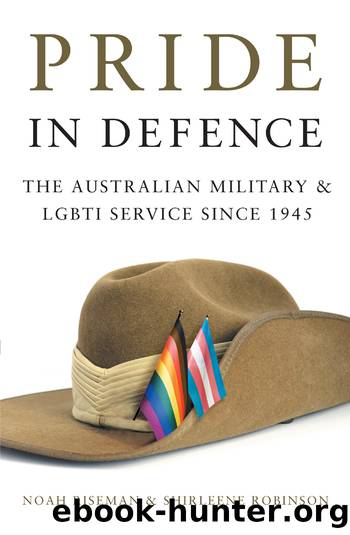
Pride in Defence by Noah Riseman
Author:Noah Riseman
Language: eng
Format: epub
Publisher: Melbourne University Publishing
Conclusion
On 24 November 1992, the CDF sent out a message, which stated:
Australians, regardless of their sexual orientation, will now be able to serve their country in the ADF without restriction ⦠The central element of the new policy is that sexual relations and activities are primarily and predominantly a private matter for each individual, and that the ADF has no concern with the sexual activities of its members provided they are not unlawful and are not contrary or inconsistent with the inherent requirements of the ADF.115
As this chapter shows, this final order to permit LGB people to serve openly came after more than two decades of courageous advocacy from LGB activists, service members, veterans and allies. Whether testifying before royal commissions, writing letters to politicians, sending anonymous letters to the press, demonstrating in public or confronting their chains of command, these brave men and women all challenged discriminatory policies and entrenched homophobic attitudes within the ADF. When the ban eventually was put on the political agenda, Attorney-General Michael Duffy championed the push for its repeal, overcoming divisions within his own party.
Interestingly, though, most interview participants who served when the ban was lifted have no memory of that historical moment, or have only vague memories of seeing an announcement or some discussion in the mess hall. âSimonâ, who was serving on HMAS Moresby when the ban was lifted, even goes as far as to say: âI donât remember it actually being much of a thing. I reckon it was more of a thing that Sydney won the Olympics, because âthe winner is Syderney [sic]â, that was the big thing.â116
Reflecting the views of many other ex-service members, former RAAF member Craig Cahill summarises: âIt was a non-event, in my opinion. I felt relieved because I donât have to deny it if anyone asked me, but there was still a lot of homophobia. Homophobia doesnât vanish overnight.â117 As chapter 5 shows, this was most certainly the case for many LGB Defence members. Although they could no longer be dismissed because of their sexuality, being openly gay, lesbian or bisexual was a still risky business for the next decade. The 1990s and early 2000s proved to be an era when courageous LGB service members and allies would need to challenge deeply entrenched cultures and policies that continued to discriminate.
Notes
1 âNavy men dischargedâ, Sydney Morning Herald, 25 January 1971, p. 3. See also âSailors outâ, Canberra Times, 26 January 1971, p. 3.
2 John Ware, to the Hon. D.J. Killen, 25 January 1971, reproduced in âFor Queen and countryâ, CAMP Ink, February 1971, p. 12.
3 D.J. Killen to J. Ware, 5 February 1971, reproduced in âKillen Repliesâ, CAMP Ink, March 1971, p, 11.
4 âSo you want to be a WRAAF?â, pp. 4â5; Hadrian, âHomosexuality in the forcesâ, p. 4; âRoyal Australian Navy ordersâ, CAMP Ink 3, no. 7 (1973), pp. 4â6; âLetter received from the Department of Defenceâ, CAMP Ink 4, no. 5â6 (1975), pp. 11â12.
5 Shilts, Conduct Unbecoming, esp. pp. 205â372; Eric Marcus (ed.), Making
Download
This site does not store any files on its server. We only index and link to content provided by other sites. Please contact the content providers to delete copyright contents if any and email us, we'll remove relevant links or contents immediately.
| Africa | Americas |
| Arctic & Antarctica | Asia |
| Australia & Oceania | Europe |
| Middle East | Russia |
| United States | World |
| Ancient Civilizations | Military |
| Historical Study & Educational Resources |
The Dawn of Everything by David Graeber & David Wengrow(1717)
The Bomber Mafia by Malcolm Gladwell(1633)
Facing the Mountain by Daniel James Brown(1563)
Submerged Prehistory by Benjamin Jonathan; & Clive Bonsall & Catriona Pickard & Anders Fischer(1461)
Wandering in Strange Lands by Morgan Jerkins(1436)
Tip Top by Bill James(1420)
Driving While Brown: Sheriff Joe Arpaio Versus the Latino Resistance by Terry Greene Sterling & Jude Joffe-Block(1380)
Red Roulette : An Insider's Story of Wealth, Power, Corruption, and Vengeance in Today's China (9781982156176) by Shum Desmond(1365)
Evil Geniuses: The Unmaking of America: A Recent History by Kurt Andersen(1359)
The Way of Fire and Ice: The Living Tradition of Norse Paganism by Ryan Smith(1342)
American Kompromat by Craig Unger(1327)
F*cking History by The Captain(1312)
It Was All a Lie by Stuart Stevens;(1306)
American Dreams by Unknown(1294)
Treasure Islands: Tax Havens and the Men who Stole the World by Nicholas Shaxson(1279)
Evil Geniuses by Kurt Andersen(1262)
White House Inc. by Dan Alexander(1219)
The First Conspiracy by Brad Meltzer & Josh Mensch(1180)
The Fifteen Biggest Lies about the Economy: And Everything Else the Right Doesn't Want You to Know about Taxes, Jobs, and Corporate America by Joshua Holland(1128)
